


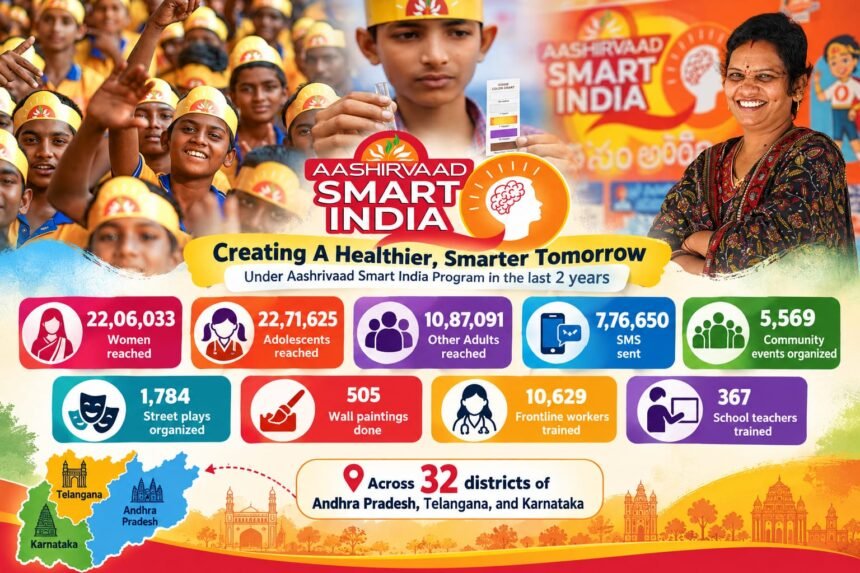
Aashirvaad’s Smart India Programme community has made significant progress in spreading awareness about iodine deficiency and healthy nutrition practices, reaching more than 13 lakh women and adolescents across 32 districts in Karnataka, Andhra Pradesh and Telangana. According to the programme’s 2025-26 endline assessment, overall iodine-related knowledge increased by 37 percentage points, while foundational knowledge about iodine improved by 26 percentage points.
The two-year initiative, led under the Aashirvaad Smart India Programme (ASIP), focused on educating women, adolescents, schoolchildren and local communities about the importance of iodine in everyday nutrition. The programme also highlighted the importance of identifying adequately iodised salt, understanding product packaging and following proper storage and cooking practices to ensure that households receive the benefits of iodine.
The findings are particularly significant in the context of public health, as iodine plays an essential role in thyroid function, physical growth and brain development. Iodine deficiency, particularly during pregnancy and childhood, can have serious and sometimes irreversible consequences for cognitive development.
Community Participation Becomes the Key to Success
Instead of limiting awareness efforts to traditional campaigns and one-time communication, the Aashirvaad Smart India Programme adopted a community-based approach. It used several interactive activities, including Iodine Sabhas, street plays, school-based activities and community demonstrations.More than 10 lakh people participated in Iodine Sabhas, while street plays reached over 3.22 lakh people. These activities helped communicate important information about iodine deficiency and encouraged families to adopt better nutrition practices.
The programme also trained 1,712 frontline workers and teachers to strengthen awareness at the grassroots level. Among the 178 schoolteachers who received training, 92% demonstrated correct knowledge about iodine, its sources and health benefits after the intervention.
Women were also encouraged to become Iodine Champions, helping them spread awareness within their families and neighbourhoods. This approach ensured that information shared during community programmes could reach more households and translate into practical everyday habits.
Focus on Correct Use and Storage of Iodised Salt
A major objective of the programme was to help people understand that simply knowing about iodine deficiency is not enough. Families must also know how to identify adequately iodised packaged salt and use it correctly. The initiative educated households about checking product information, storing salt appropriately and following suitable cooking practices to retain its nutritional value.
India’s National Iodine Deficiency Disorders Control Programme aims to ensure household consumption of adequately iodised salt containing 15 parts per million (ppm) of iodine. Sustained public awareness and community participation remain important components of this national effort.
ITC Highlights the Importance of Community-Led Nutrition Awareness
Commenting on the programme’s achievements, Anuj Rustagi, Business Unit Chief Executive – Staples Business, Foods Division, ITC Ltd, said that the Aashirvaad Smart India Programme reflects the company’s commitment to addressing public health challenges through sustained community engagement.
He noted that communicating scientific information through simple messages and locally relevant methods can improve public understanding and encourage informed household practices. He also highlighted the important contribution of women, schoolchildren, teachers and frontline workers in taking nutrition-related messages deeper into communities.
Experts Emphasise the Serious Impact of Iodine Deficiency
Dr. Shantanu, Director, Institute for Global Development, highlighted the serious consequences of iodine deficiency, particularly for children and pregnant women. He explained that community education should go beyond simply communicating the importance of iodised salt. Families must also understand how to identify, store and use salt properly while cooking.
Public Health and Nutrition Expert Dr. Ranjan Sankar also highlighted the need to address inadequate iodine consumption in certain states. He emphasised that people should reduce their overall salt intake while ensuring that the salt they consume is adequately iodised. He referred to the recommended maximum daily salt intake of 5 grams.
Experts Discuss Iodine’s Role in Building Healthier Communities
The programme’s findings were presented during a webinar titled Building Stronger Minds and Healthier Communities with Iodized Salt, organised by ASIP in association with the Institute for Global Development.
Experts participating in the discussion highlighted the relationship between iodine, thyroid function and cognitive development. They also discussed the objectives of India’s National Iodine Deficiency Disorders Control Programme and the importance of community-based nutrition education.The endline assessment recorded statistically significant improvements in knowledge scores, highlighting the importance of repeated awareness activities, practical demonstrations and locally accessible communication.
With more than 13 lakh women and adolescents reached across 32 districts, the Aashirvaad Smart India Programme demonstrates how sustained community participation can strengthen nutrition awareness and encourage healthier household practices. The initiative also underlines the important role women, teachers and frontline workers can play in supporting India’s efforts to prevent iodine deficiency disorders.