



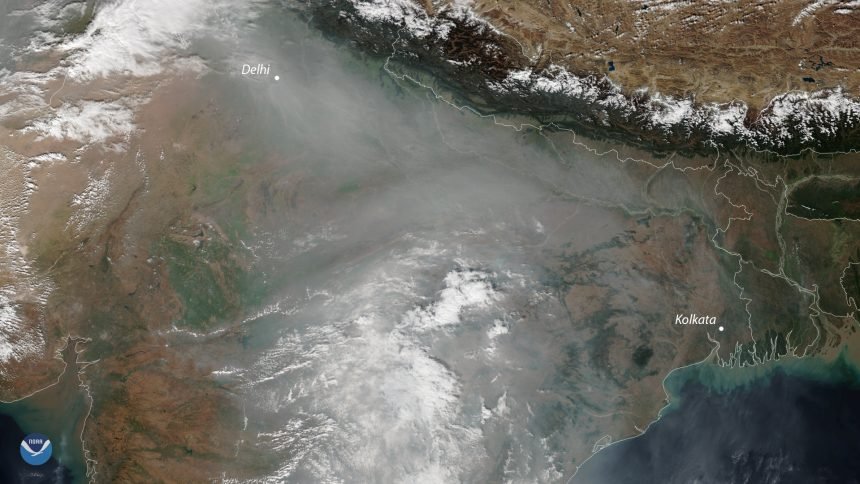
New Delhi – The Commission for Air Quality Management pushed back its deadline for large and medium industrial units in Delhi and the surrounding region from 1 August to 1 October 2026, after most covered units had not completed the required pollution control upgrades.
The requirement itself is a tightened particulate limit of 50 milligrams per normal cubic metre for 17 categories of industry, issued under Direction No. 98. Separately, the Central Pollution Control Board has directed all 17 categories of highly polluting industries to install online continuous emission monitoring systems.
Continuous monitoring is the real shift
Periodic sampling tells a regulator what a stack emitted on the day an inspector visited. Continuous monitoring reports what it emits at three in the morning on a Sunday.
That is a different compliance regime, and it explains why installation has run behind schedule. Equipment cost is part of it. The larger obstacle is that continuous data exposes operating practices that intermittent sampling never captured.
The national programme is missing its marks
The National Clean Air Programme, launched in 2019 and covering more than 130 cities, was revised toward roughly a 40 per cent reduction in particulate levels by 2026, with city-wise annual targets and central grants attached.
Outcomes have been uneven. Fifty-one cities met the original target of a 20 to 30 per cent cut in PM10. Twenty-three reached the revised 40 per cent goal. Against more than 130 cities in the programme, that is a minority.
Why the airshed framing matters
CAQM is among the few Indian bodies whose jurisdiction follows the pollution rather than the state boundary, covering parts of Haryana, Uttar Pradesh and Rajasthan alongside Delhi. Air does not stop at a border, and a city-by-city programme in a shared airshed will always struggle.
Source: Commission for Air Quality Management directions, Central Pollution Control Board monitoring requirements, and National Clean Air Programme progress reporting.