


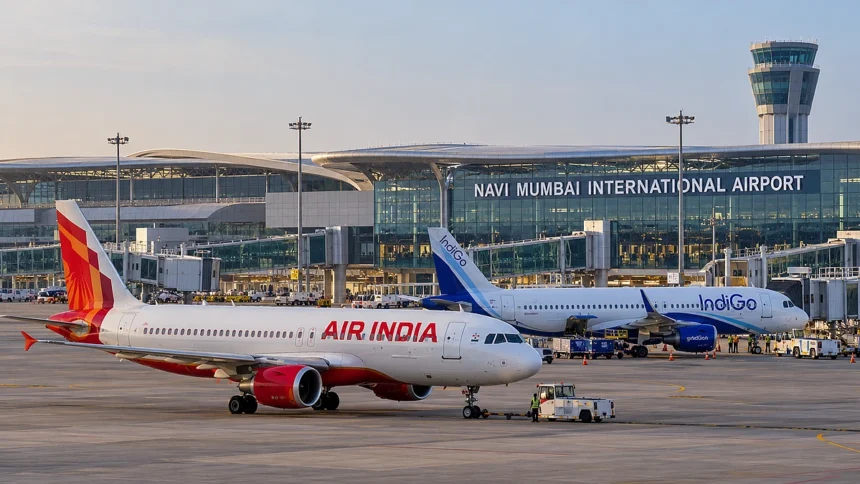
Mumbai Airport T1 Redevelopment: Mumbai’s aviation sector is set for a major infrastructure upgrade as IndiGo and Air India have agreed to shift part of their operations to the upcoming Navi Mumbai International Airport (NMIA), paving the way for the phased redevelopment of Terminal 1 at Chhatrapati Shivaji Maharaj International Airport (CSMIA). The planned move is expected to ease pressure on Mumbai’s existing airport infrastructure while enabling safety improvements, modernisation and increased passenger-handling capacity at Terminal 1.
Mumbai Airport T1 Redevelopment
The decision follows nearly 18 months of consultations between the airport operator and airlines to plan a coordinated transition. The initial phase aims to shift around 5 million passengers to Navi Mumbai, with approximately 3 million passengers expected to be accounted for by the participation of the two major domestic carriers. This would represent around 60% of the passenger traffic targeted for relocation during the first phase.
IndiGo and Air India’s Move to Support Terminal 1 Redevelopment
The proposed transfer of selected airline operations is intended to create the space needed to undertake redevelopment work at CSMIA Terminal 1. The airport operator has highlighted the need to upgrade existing infrastructure to meet safety requirements, improve passenger facilities and accommodate the growth in air travel. According to the redevelopment plan, around 9% of CSMIA’s annual passenger traffic of approximately 55 million passengers is expected to be temporarily shifted as part of the Terminal 1 project. The remaining 91% of passenger traffic will continue to operate from Mumbai Airport.
The redevelopment is expected to increase Terminal 1’s annual passenger-handling capacity by approximately 33%, from 15 million to 20 million passengers. The upgraded terminal is planned to feature modern passenger facilities, improved processing systems and digital technologies to support more efficient airport operations.
The airport operator has also stated that airlines’ historical slots at CSMIA will be restored after the redevelopment is completed. This arrangement is intended to facilitate the temporary transition without permanently disrupting airlines’ established operations at Mumbai’s existing airport.
Navi Mumbai Airport to Strengthen Mumbai’s Aviation Infrastructure
The development of NMIA alongside CSMIA is expected to help Mumbai evolve into a dual-airport gateway. Distributing passenger traffic between the two airports could ease capacity constraints, improve operational flexibility and provide additional room for future growth in domestic and international air travel.
Connectivity is also expected to play an important role in NMIA’s growth. In addition to the existing road network, three bridges built by the City and Industrial Development Corporation of Maharashtra (CIDCO)—SBR-9, BR-4 and BR-5—across Panvel Creek and the Gadhi River are expected to improve connectivity between the airport, Atal Setu, Ulwe Coastal Road, Amra Marg and NH-4B.
Better road access is expected to benefit passengers, airline employees and businesses operating across the Mumbai Metropolitan Region. Planned multimodal transport links are also expected to strengthen access to key urban centres, commercial districts and logistics hubs.
Modern Facilities and Technology at Navi Mumbai International Airport
Navi Mumbai International Airport has been designed with scalable infrastructure to support growing passenger demand. Its Terminal 1 is planned to handle up to 20 million passengers annually, with future expansion expected to increase the airport’s overall capacity to 90 million passengers.
The airport’s proposed facilities include advanced passenger-processing systems, Digi Yatra, automated baggage handling and integrated digital platforms. These systems are intended to improve passenger movement, reduce processing time and support efficient airline operations.
NMIA is also expected to offer dedicated cargo facilities, specialised cold-chain infrastructure and inflight catering services. Its proximity to major ports and industrial centres could strengthen its role in air cargo and logistics. Hospitality facilities, retail outlets, dining options, passenger lounges and Indian cultural experiences are also expected to contribute to the overall passenger experience. Sustainable design and phased infrastructure expansion are intended to support the airport’s long-term development as passenger demand grows.
Mumbai’s Dual-Airport System Could Expand International Connectivity
The development of Navi Mumbai alongside CSMIA could create new opportunities to expand Mumbai’s international air connectivity. With additional capacity available across two airports, airlines could have greater scope to introduce new routes, increase frequencies and improve connections between domestic and international services.
The participation of IndiGo and Air India provides an important foundation for NMIA’s operational growth. As the airport builds its operational track record and expands its network, it could attract greater participation from international carriers and offer passengers more travel options.
A stronger dual-airport system could also help Mumbai attract international transfer traffic and improve India’s position in the global aviation network. Better connectivity would benefit tourism, business travel, trade and investment while supporting the country’s ambition to become a major international aviation hub.
Terminal 1 Upgrade to Prepare Mumbai Airport for Future Demand
The redevelopment of CSMIA Terminal 1 is aimed at addressing infrastructure and safety requirements while preparing the facility for future passenger growth. The project is expected to introduce upgraded facilities, improved digital systems and more efficient passenger-processing arrangements.
Temporarily shifting selected operations to NMIA is intended to create the necessary space for redevelopment while allowing most passenger traffic to continue using Mumbai Airport. Once completed, the modernised terminal is expected to provide additional capacity and a better passenger experience.
Mumbai Airport T1 Redevelopment
The combined development of CSMIA and NMIA represents a significant step in Mumbai’s aviation infrastructure planning. By upgrading the existing terminal and developing a second major airport, the city aims to accommodate rising air travel demand, strengthen international connectivity and support its long-term economic growth.