



New Delhi – Battery storage tariffs in India have fallen by an estimated 86 per cent since 2022, and the subsidy needed to make projects viable has fallen with them.
Viability gap funding for grid-scale storage opened at roughly 46 lakh rupees per megawatt hour in early first-tranche awards. The first tranche settled near 27 lakh, about 30 per cent of capital cost. The second tranche, from July 2025, cut that to around 18 lakh as system costs dropped.
In May 2026 the Union Cabinet approved a further 5,400 crore rupees from the Power System Development Fund to support 30 gigawatt hours of new capacity.
A pipeline far larger than the fleet
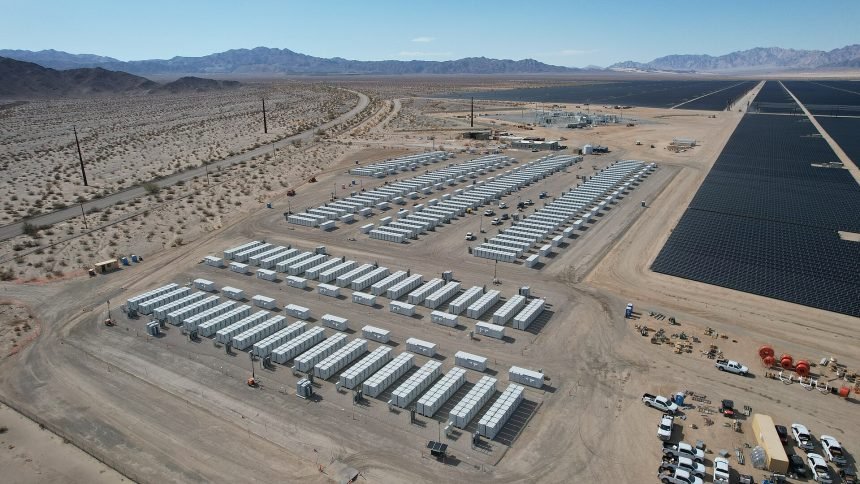
Around 69 storage tenders totalling roughly 102 GWh were floated during 2025. Commissioned capacity at the end of that year stood at 758.4 megawatt hours.
The distance between those figures is mostly construction time, at eighteen to twenty-four months from award. Grid-scale capacity reached about 1.8 GWh by March 2026, with most of it energised in the preceding six months, which suggests the pipeline is beginning to convert.
Why storage decides the renewable target
India solar capacity now substantially exceeds wind, and solar generates in a narrow daily window that does not match the evening demand peak. Without storage, surplus midday generation is curtailed and evening demand is met by coal.
This is why tenders have shifted toward four-hour systems capable of overnight balancing rather than shorter-duration frequency support. Four hours is roughly what it takes to carry an Indian evening peak.
The unresolved constraint
Cells are imported. A storage build-out at the scale being tendered, resting on an Advanced Chemistry Cell programme that has delivered a fraction of its target, carries the same supply chain exposure as the electric vehicle sector, and the two will compete for the same cells.
Source: Union Cabinet approval of Power System Development Fund outlay, SECI and NTPC tender records, and storage tariff analysis published in 2026.