


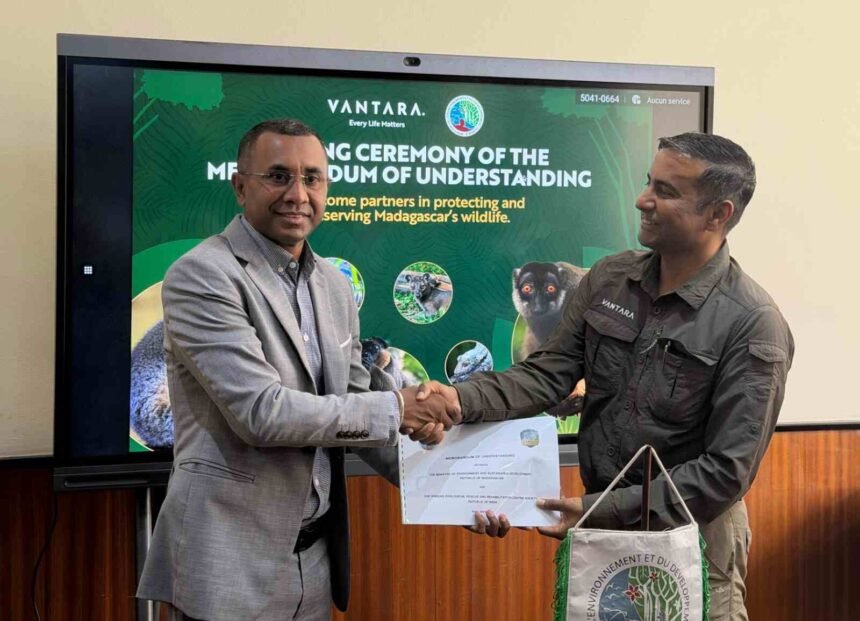
Vantara Madagascar Partnership: In a major international conservation initiative, Vantara, the animal welfare and conservation organisation based in Jamnagar, Gujarat, has signed a 10-year partnership with the Government of Madagascar to protect endangered wildlife and strengthen conservation efforts in the African island nation. The agreement has been signed between Madagascar’s Ministry of Environment and Sustainable Development (MEDD) and the Greens Zoological Rescue and Rehabilitation Centre Society, which operates Vantara. The partnership aims to protect Madagascar’s unique wildlife through animal rescue, rehabilitation, veterinary care, scientific research and long-term conservation programmes.
Under the non-exclusive Memorandum of Understanding (MoU), Vantara will support the safe return of Malagasy animals seized in other countries, strengthen wildlife rescue and rehabilitation facilities, and help train local conservation professionals. The partnership also includes plans to establish a national wildlife conservation and rehabilitation centre in Madagascar. The agreement fulfils a commitment made by Vantara to India’s CITES Management Authority on August 19, 2026.
Vantara to Help Bring Trafficked Animals Back to Madagascar
One of the key objectives of the partnership is to ensure that animals belonging to Madagascar are returned safely to their natural country of origin after being seized abroad. Wildlife trafficking often leaves animals physically weak, injured and vulnerable to diseases. Their survival can depend on proper veterinary treatment, transportation and quarantine arrangements. Under the agreement, Vantara will provide technical and veterinary support, including health assessments, disease screening, transportation, quarantine and post-arrival care, whenever requested by Madagascar.
The organisation will also share scientific expertise, including field research and genetic profiling, to help determine which rescued animals can safely return to the wild and identify suitable habitats for their rehabilitation. All decisions regarding the animals’ rehabilitation and possible release into natural habitats will remain exclusively with the Government of Madagascar, guided by its CITES Scientific Authority and relevant international conservation guidelines.
New National Wildlife Rescue and Rehabilitation Centre Planned
Another major component of the 10-year partnership is the proposed establishment of Madagascar’s National Wildlife Rescue and Rehabilitation Centre. Vantara may support the construction and development of this national facility, which will serve as a centre for wildlife rescue, veterinary treatment, conservation research and professional training. Importantly, the centre will remain the property of the Republic of Madagascar and operate under the authority of its Ministry of Environment and Sustainable Development. The land for the facility will be provided by the Madagascar government.
The partnership will also focus on developing local expertise through specialised training programmes, internships, professional exchanges and applied research. These initiatives are expected to strengthen the ability of Malagasy wildlife professionals to rescue, treat, rehabilitate and, wherever scientifically appropriate, return animals to their natural habitats.
Why Madagascar Needs Urgent Wildlife Conservation Support
Madagascar is recognised as one of the world’s most important biodiversity hotspots. Its forests and ecosystems are home to several unique animal species that are not naturally found anywhere else on Earth. However, the country’s wildlife faces growing threats from habitat destruction, illegal hunting and international wildlife trafficking. According to the IUCN Red List of Threatened Species, approximately 90% of lemur species are threatened with extinction, with nearly one-third classified as Critically Endangered.
The situation is equally concerning for the radiated tortoise, one of Madagascar’s most threatened species. According to the Turtle Survival Alliance, its wild population declined by more than 47% between the late 1990s and 2013. Madagascar also lost approximately 29% of its tree cover between 2001 and 2023, further threatening the natural habitats of its wildlife. The scale of illegal wildlife trafficking has added to these challenges. Between January and April 2026, rescuers in Madagascar received more than 1,000 tortoises from six confiscation cases.
An earlier incident involving Thai authorities in 2024 highlighted the dangers faced by trafficked animals. Authorities intercepted 48 lemurs and more than 1,000 tortoises, but 131 tortoises had already died during transportation. Some other animals also failed to survive in the following weeks. The repatriation process faced delays because of funding limitations and complex international permit procedures. The new partnership aims to address such challenges by creating better coordination, veterinary support and infrastructure for the safe return of wildlife.
Vantara Madagascar Partnership: What Madagascar and Vantara Said About the Partnership
H.E. Nolave Luck Aristide Andriatsihala, Minister of Environment and Sustainable Development of Madagascar, said the country’s wildlife is an important part of its national identity and natural heritage. He emphasised that protecting these species requires international cooperation and appreciated the support of organisations such as Vantara in safeguarding Madagascar’s biodiversity.
Rakotondravoninala Valison Kiady, Director General of Environmental Governance at MEDD, said Vantara’s expertise in animal rescue, veterinary care and welfare would help translate the agreement into practical conservation programmes. He added that the partnership would focus on immediate action as well as long-term initiatives guided by science, regulations and international best practices. Vivaan Karani, Chief Executive Officer of Vantara, said protecting wildlife in its natural habitat is central to the organisation’s ten-year conservation strategy.
He highlighted that the priority is to strengthen local institutions and conservation professionals in the countries where endangered animals naturally belong. He also underlined that all decisions concerning Madagascar’s wildlife would remain with the Government of Madagascar.
Vantara Madagascar Partnership: Vantara’s Focus on Conservation Beyond Borders
The partnership reflects Vantara’s broader approach to wildlife conservation, which combines protection of animals in their natural habitats with rescue, veterinary treatment and rehabilitation when required. Its focus is on strengthening conservation capabilities within the countries of origin rather than separating rescued animals from their natural ecosystems. Through this 10-year agreement, Vantara and Madagascar aim to build stronger conservation infrastructure, develop local expertise and improve the survival prospects of endangered species. Vantara Madagascar Partnership News
Vantara Madagascar Partnership: The initiative also highlights the growing importance of international cooperation in addressing wildlife trafficking and biodiversity loss. By combining scientific knowledge, veterinary expertise and local conservation leadership, the partnership seeks to create long-term benefits for Madagascar’s wildlife and natural heritage.