



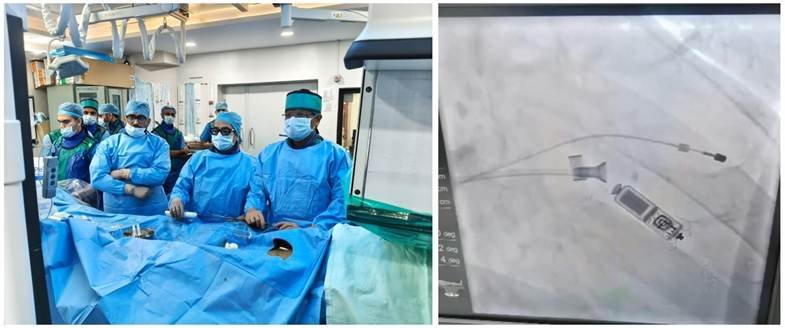
Western Railway Jagjivan Ram Hospital (JRH), located at Mumbai Central, has achieved a significant breakthrough in cardiac care by successfully implanting a leadless pacemaker in a 43-year-old patient suffering from a rare combination of heart conditions Hypertrophic Cardiomyopathy, Dextrocardia and Situs Inversus. The procedure is being described as the first of its kind in India and among the few such cases reported worldwide.
The successful surgery marks an important milestone for the hospital’s Cardiology Department, demonstrating its ability to handle highly complex cardiac cases using advanced medical technology. The procedure was particularly challenging because of the patient’s unusual internal anatomy and a history of repeated complications with conventional cardiac devices.
Western Railway Jagjivan Ram Hospital: Rare heart condition posed major treatment challenges
According to a press release issued by Western Railway Chief Public Relations Officer Arun Kumar Meena, the patient had been referred to Jagjivan Ram Hospital from Central Railway. The patient was diagnosed with Dextrocardia and Situs Inversus, rare congenital conditions in which the heart and other internal organs are positioned in a mirror-image arrangement compared to their normal anatomical locations.
The patient had undergone multiple procedures over the past two years for the implantation and replacement of cardiac devices. However, recurring complications made the treatment increasingly difficult. Even after another implantation attempt at Jagjivan Ram Hospital, similar complications emerged, forcing doctors to remove the device within a month of its implantation. Following the removal, the patient was supported with a temporary pacemaker while the medical team evaluated alternative treatment options.
Western Railway Jagjivan Ram Hospital: Leadless pacemaker emerged as a breakthrough solution
The biggest challenge for the doctors was the absence of safe vascular access for implanting a conventional cardiac device. Traditional pacemakers generally require leads, or thin wires, to connect the device to the heart. In this patient’s case, the unusual anatomy and previous complications made the conventional approach unsuitable. After carefully assessing the patient’s condition, the Cardiology team decided to adopt an advanced treatment approach and implant a leadless pacemaker. The team successfully implanted the MICRA AV1 device, overcoming the anatomical and technical challenges associated with Dextrocardia and Situs Inversus.
Western Railway Jagjivan Ram Hospital: First-of-its-kind procedure in India
Unlike conventional pacemakers, a leadless pacemaker is a small, self-contained device implanted directly inside the heart. It does not require traditional pacing leads or a surgically created pocket beneath the skin, thereby avoiding some complications associated with conventional pacemaker systems. The successful implantation represents a major achievement in the management of patients who have limited options for conventional cardiac device implantation.
Expert guidance behind the complex procedure
The procedure was performed by the Cardiology team at Jagjivan Ram Hospital, comprising Dr Shishir Kumar Roul, Dr Avinash Arke and Dr T. N. Sreekanth. The team received expert guidance from Dr Vanita Arora, Senior Electrophysiologist at Indraprastha Apollo Hospital, Delhi, and President of the Indian Heart Rhythm Society. The collaboration between the hospital’s cardiology specialists and an experienced electrophysiologist played an important role in successfully managing the unusual anatomical challenges involved in the procedure.
Boost for advanced cardiac treatment at railway hospitals
The achievement highlights the growing capabilities of Jagjivan Ram Hospital in providing advanced cardiac treatment and managing challenging medical conditions. It also underlines the importance of adopting innovative technologies when conventional treatment methods are not suitable for patients. For individuals with rare congenital heart conditions or repeated complications from conventional pacemakers, leadless pacing technology can offer an alternative in carefully selected cases. However, the suitability of such devices depends on individual medical conditions and clinical assessment.
Western Railway stated that the achievement reflects its continued commitment to delivering quality healthcare services and strengthening advanced medical facilities for its beneficiaries. With this successful procedure, Jagjivan Ram Hospital has added a significant milestone to its medical achievements, placing its Cardiology Department in the spotlight for handling one of the most technically challenging pacemaker implantation cases reported in the country.